
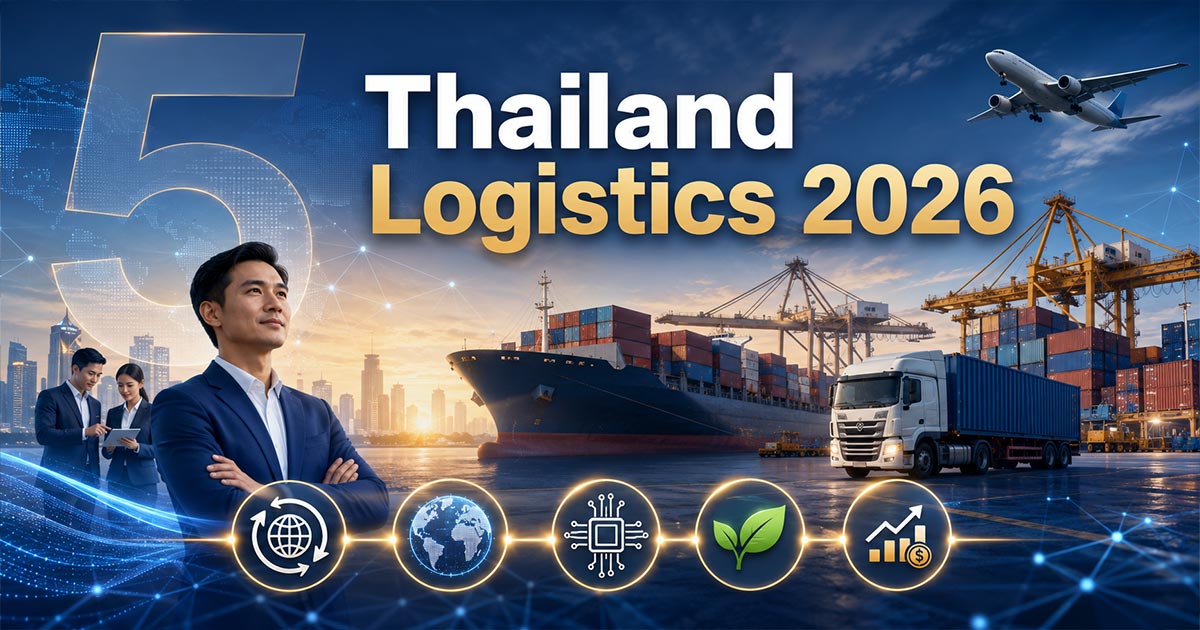
Thailand’s logistics industry continues to play an important role in the country’s economic development. With its strategic location in Southeast Asia, connection to regional supply chains, industrial zones, ports, airports, border routes, and manufacturing activity, Thailand remains an important logistics hub for both domestic and international trade.
In 2026, however, the logistics business environment is more complex than before. Growth opportunities still exist, but businesses also need to manage risks from global trade uncertainty, geopolitical tensions, digital disruption, sustainability requirements, and cost pressure.
For logistics providers, importers, exporters, manufacturers, and supply chain operators, understanding these opportunities and challenges is important for planning business strategy and improving operational resilience.
1. International Trade and Regional Supply Chains Continue to Create Opportunities
One of the key opportunities for Thailand’s logistics industry in 2026 is the continued role of international trade and regional supply chain connectivity.
Thailand is strategically located within ASEAN and connected to important trade flows across road, sea, air, and cross-border routes. This position supports logistics activities in areas such as:
- freight forwarding
- customs-related coordination
- sea freight
- air freight
- inland transportation
- warehousing
- cross-border logistics
- industrial supply chain support
As companies diversify supply chains and review sourcing strategies, Thailand may continue to benefit from its manufacturing base, infrastructure development, and regional connectivity.
However, trade growth should not be viewed as guaranteed. Global trade in 2026 is still affected by changing tariffs, protectionist policies, economic uncertainty, and shifting supply chain strategies. Logistics companies therefore need to remain flexible and avoid relying too heavily on a single market, route, or customer group.
2. Geopolitical Tensions Increase Supply Chain Risk
Geopolitical uncertainty remains one of the major challenges for global logistics.
Conflicts, trade tensions, sanctions, route disruptions, and instability around key maritime passages can directly affect shipping routes, transit times, insurance costs, fuel prices, freight rates, and cargo planning.
For logistics businesses and import-export operators, these risks may lead to:
- longer transit times
- higher freight costs
- schedule instability
- route changes
- port congestion
- additional insurance or security-related costs
- uncertainty in delivery planning
This means logistics planning in 2026 must focus not only on cost efficiency, but also on resilience.
Businesses may need to prepare alternative routes, diversify suppliers, improve shipment visibility, and communicate more clearly with customers when external disruptions occur.
3. Digital Transformation and Cybersecurity Become Essential
Digital transformation is no longer optional for logistics companies. In 2026, customers and partners increasingly expect better shipment visibility, faster document coordination, real-time updates, and more transparent communication.
Technology can help logistics businesses improve operations in several ways:
- shipment tracking
- digital documentation
- warehouse management
- route planning
- customer updates
- cloud-based data sharing
- AI-assisted planning
- supply chain dashboards
- automated workflow management
At the same time, digital transformation also increases cybersecurity risk. Logistics companies handle sensitive information such as shipment data, customer details, commercial invoices, customs documents, partner records, and payment-related information.
If these systems are not properly protected, cyber incidents can disrupt operations, delay shipments, expose confidential data, and damage customer trust.
For this reason, logistics companies should develop digital capabilities together with stronger cybersecurity practices. Technology should improve visibility and efficiency, but it must also protect business-critical data.
4. Sustainability and Green Logistics Create Both Pressure and Opportunity
Sustainability is becoming a more important issue in logistics and international trade.
The transportation sector is under increasing pressure to reduce emissions, use resources more efficiently, and support more responsible supply chain practices. In maritime shipping, international sustainability goals are pushing the industry toward lower carbon intensity and cleaner energy options.
For logistics businesses, sustainability may create both challenges and opportunities.
Challenges may include:
- higher compliance requirements
- pressure to measure emissions
- potential cost increases from cleaner operations
- customer requirements for greener supply chains
- investment in more efficient systems or equipment
Opportunities may include:
- stronger positioning with corporate customers
- better route and transport efficiency
- lower waste from better planning
- improved partner selection
- long-term readiness for future trade requirements
However, businesses should be careful with sustainability claims. Green logistics should be based on real practices, measurable improvements, or clear operational policies rather than broad marketing statements.
5. Inflation, Interest Rates, and Operating Costs Still Affect Logistics Businesses
Cost pressure remains a major issue for logistics companies and supply chain operators.
Even when inflation becomes more stable, businesses may still face high operating costs from fuel, labor, vehicle maintenance, warehouse rent, equipment, insurance, finance costs, and technology investment.
For logistics businesses, cost pressure can affect pricing, margins, service quality, and investment decisions.
Key cost-related challenges may include:
- fuel price volatility
- higher labor and driver costs
- warehouse and land cost pressure
- capital cost for fleet or equipment investment
- technology implementation costs
- freight rate volatility
- customer pressure to control logistics spending
To manage these challenges, logistics businesses need better cost visibility and more disciplined operational planning.
This may include route optimization, shipment consolidation, better warehouse utilization, improved documentation accuracy, and stronger collaboration with partners.
Connected Services and the Role of Logistics in Economic Development
Logistics is not only a standalone business sector. It is also a connected service that supports other industries.
Manufacturing, retail, e-commerce, agriculture, healthcare, automotive, electronics, construction, and import-export businesses all depend on reliable logistics services.
When logistics services improve, other sectors can also become more competitive. Better transportation, warehousing, financial services, digital systems, and business support services can help companies operate more efficiently and access wider markets.
This is why logistics development matters not only for logistics companies, but also for the broader economy.
How Thai Logistics Businesses Should Prepare for 2026
To respond to opportunities and challenges in 2026, logistics businesses should focus on practical improvements rather than short-term reactions.
Key areas to review include:
- trade route and customer diversification
- shipment visibility and communication
- documentation accuracy
- digital workflow and cybersecurity
- cost control and resource utilization
- sustainability practices
- partner network strength
- contingency planning for disruptions
Businesses that can combine operational reliability, digital capability, and flexible planning will be better positioned in a more complex logistics environment.
Logistics in 2026 Requires Resilience, Not Only Speed
The logistics industry in 2026 is shaped by both growth and uncertainty.
International trade, e-commerce, infrastructure, and supply chain connectivity create opportunities for Thai logistics businesses. At the same time, geopolitical risk, cost pressure, sustainability requirements, and digital security create challenges that cannot be ignored.
The businesses that succeed will not be those that compete only on speed or price. They will be the ones that build resilient logistics systems, communicate clearly, manage risk, and support customers across a changing supply chain environment.
